For as long as football has been played, fans, pundits, and journalists have argued over who the best players truly are. One week, a striker is a hero for scoring a tap-in; the next, an invisible defensive midfielder gets entirely ignored despite stopping five counter-attacks.
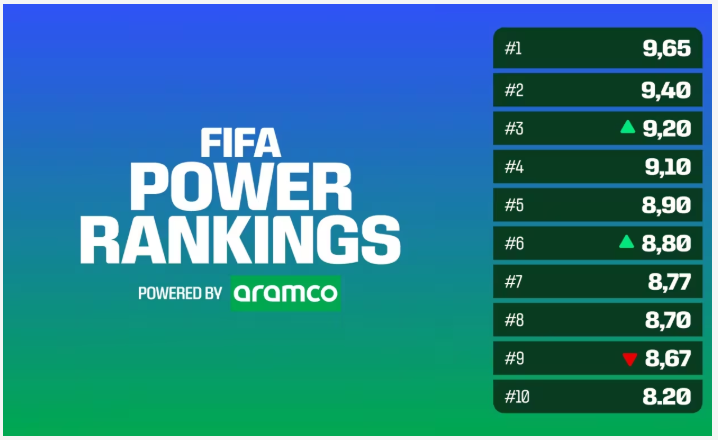
At the 2026 FIFA World Cup™, FIFA has officially declared war on pure subjectivity. Partnering with their exclusive energy partner, FIFA has launched the FIFA Power Rankings powered by Aramco—a revolutionary, data-driven individual tracking system that brings objective, cold, hard science to player evaluation on the grandest stage of all.
Developed under the visionary guidance of FIFA's Chief of Global Football Development, Arsène Wenger, this system ensures that performance will no longer be judged by reputation or biased opinion alone.

How Does the Scoring System Work?
The foundation of the rankings relies on FIFA’s unique, in-depth match data processed through advanced Enhanced Football Intelligence algorithms. Instead of just tracking simple numbers like goals or basic passes, the algorithm measures structural impact—such as bypassing opposition lines, recovering loose balls under immense pressure, and creating high-leverage scoring avenues.
Every single player on the pitch receives a live-updating score between 0 to 10 based on their specific responsibilities.
- For Outfield Players: Performance is broken down into three distinct, highly detailed columns: Attacking, Creativity, and Defending.
- For Goalkeepers: Because their roles are entirely unique, shot-stoppers are evaluated through two modern pillars: In Possession (their ability to distribute and build out from the back) and Defending the Goal (saves, collections, and goal prevention).
The 'Power Rankings Classification'
Once the opening round of group matches concluded across North America, FIFA published its historic first Power Rankings Classification, shining a massive spotlight on the top 100 players across every single category.
Rather than sitting as a static list, this leaderboard serves as a living, breathing document. The algorithm updates every single player's rating immediately after the final whistle of every match, tracking both their isolated single-game performance and their weighted, cumulative impact throughout the entire tournament.
Early Data Leaders: Cream Rises to the Top
The system didn't take long to prove its accuracy. Following the opening round of fixtures:

- Lionel Messi instantly dominated the Attacking matrix with an 8.1 score after his dazzling hat-trick against Algeria.
- Michael Olise and Kylian Mbappé saw massive analytical jumps following France's masterclasses, with Mbappé commanding the attacking tier and Olise holding down the throne in Creativity.
- Unsung heroes are also getting their flowers. Defensive pillars like Canada's Derek Cornelius and Cape Verde's Pico Lopes have found themselves ranking comfortably in the elite top tiers for Defending, proving that the hard work of holding players and center-backs will no longer go unnoticed.
The New Global Standard
By tracking subtle off-the-ball movements, positioning, and high-intensity pressures, the FIFA Power Rankings are doing something truly beautiful: validating the eye test with undeniable mathematics.
Whether you are a casual fan checking the FIFA App to see who is dominating the tournament, or a scout analyzing the data trends heading into the high-stakes Round of 16, the footballing landscape has officially changed forever. The data revolution is here, and the race to finish as the statistically proven king of the 2026 World Cup is officially on.
Comments
0 comments on this story
Post anonymously without any email address. Comments are moderated by the site and are kept private.
No comments yet. Share your view on the match, transfer, or analysis.